
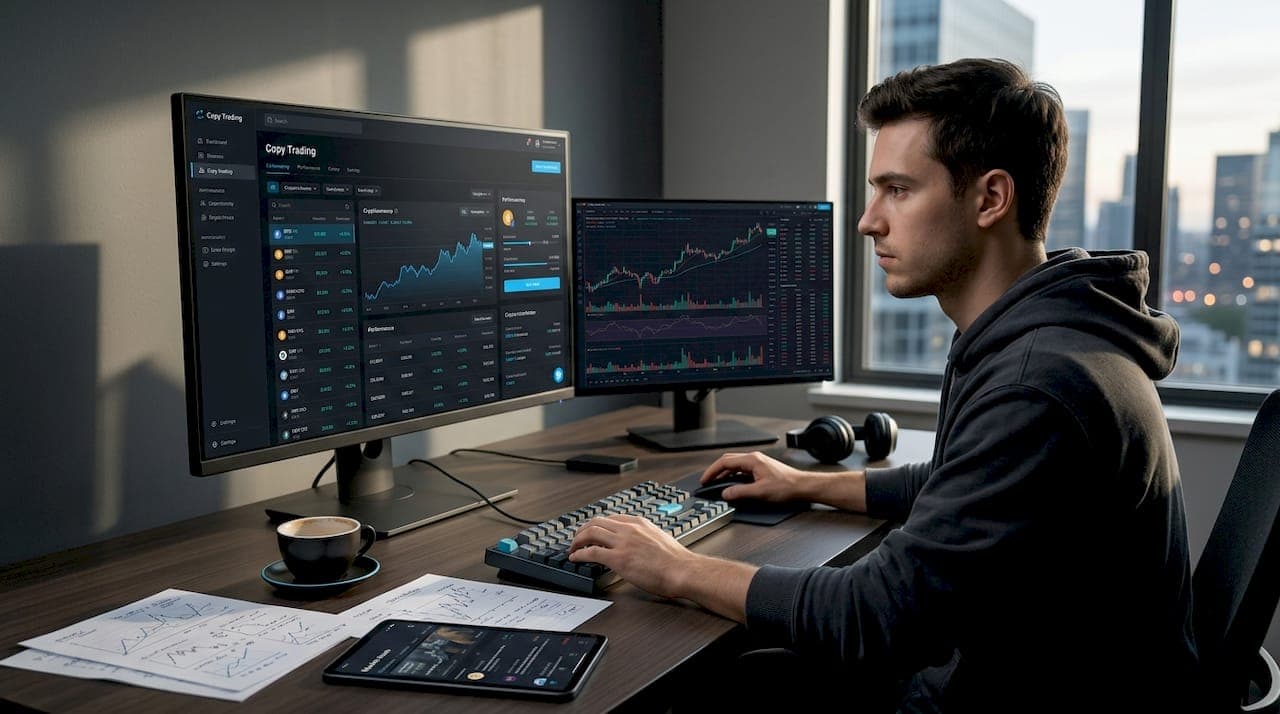
Copy trading in crypto is the automatic mirroring of a lead trader's positions into your own account in real time. For anyone looking to start copying crypto trades as a beginner, this method offers direct market exposure without requiring you to analyze charts, time entries, or manage every trade manually. Platforms like Binance, OKX, and Bybit have built copy trading features directly into their interfaces, making the process accessible even with zero prior experience. The catch is that copying trades is not passive income. It is delegated execution, and your results depend entirely on how well you choose and manage the traders you follow.
What you need before you start copying crypto trades
Before you place a single copy trade, three things must be in order: the right platform, the right account setup, and a clear understanding of what you are actually copying.
Choosing your platform is the first decision. Copy trading is offered mainly by centralized exchanges like Binance, OKX, and Bybit, each with different product models affecting how trades are mirrored. Binance Copy Trading covers spot and futures. OKX and Bybit lean heavily toward perpetual futures. If you want to track on-chain wallets instead, tools like Jupiter on Solana allow wallet-mirroring, though execution timing is less predictable there.
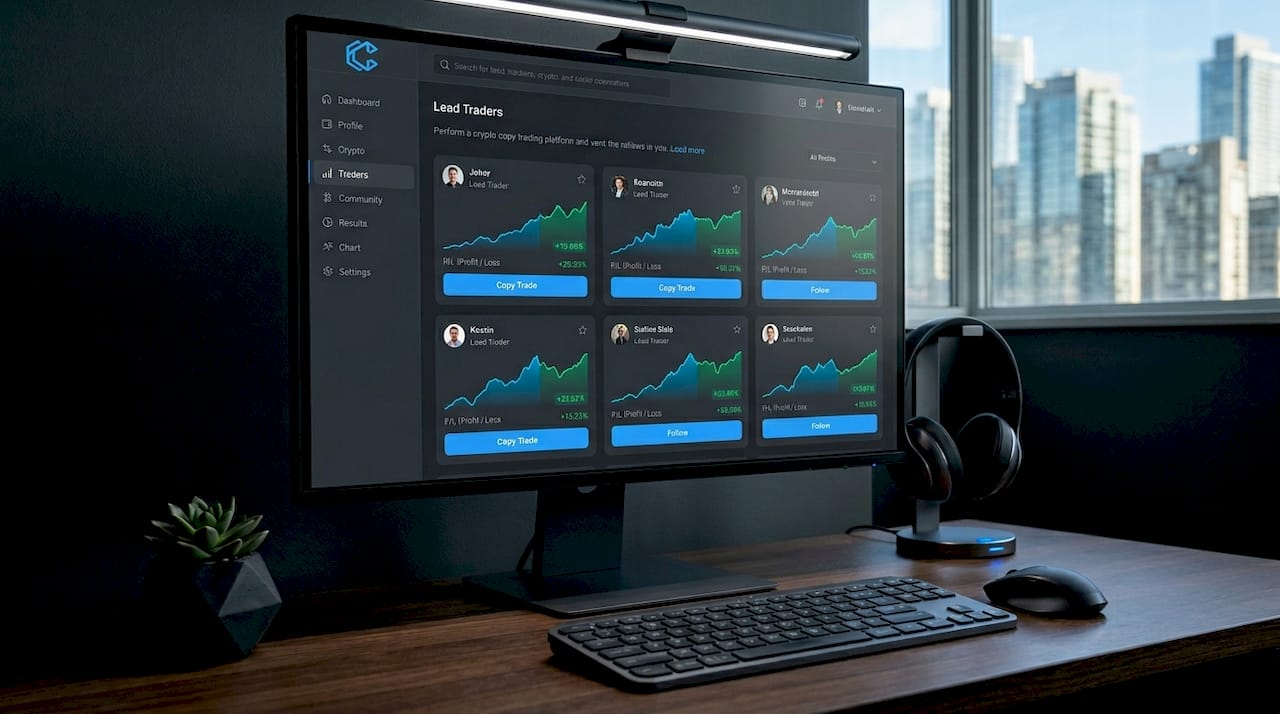
Understanding product types matters more than most beginners realize. Spot copy trading is recommended for beginners over leveraged futures because it removes liquidation risk entirely. Futures copying amplifies both gains and losses, and a lead trader running 10x leverage will expose you to drawdowns you may not expect. Start with spot. Move to futures only after you understand how leverage affects your actual position size.
Confirming legal access is a step many skip. Platform providers may require licenses depending on whether they execute orders or merely signal them. As a follower, you typically do not need a license, but you do need to confirm the platform operates legally in your region and has completed KYC verification requirements before funding.
Here is what to have ready before you begin:
- A verified account on your chosen platform with KYC completed
- Starting capital of $1,000 to $2,000, which is the recommended beginner range spread across 4 to 6 lead traders
- A clear decision on spot versus futures copying
- Basic familiarity with the platform's copy trading dashboard and fee structure
Pro Tip: Read the platform's copy trading disclosure page before funding. Platforms complying with frameworks like MiCAR are required to publish risk warnings and execution details. If you cannot find a disclosure page, treat that as a red flag.
How to select and evaluate traders to copy
Trader selection is where most beginners either win or lose before a single trade executes. The most common mistake is chasing traders with impressive short-term returns rather than assessing long-term risk metrics. A trader who turned $500 into $5,000 in two weeks is not a good candidate. A trader with 180 days of consistent equity growth and a max drawdown under 20% is.
Here is the evaluation framework to apply to every trader you consider:
- Check the equity curve, not just the return percentage. A smooth upward curve with shallow dips signals consistent strategy. A jagged curve with large spikes signals luck or high-risk bets.
- Review max drawdown over at least 90 days. Durable performance assessment depends on drawdown tolerance, not headline returns. A trader who returned 200% but drew down 60% at one point could wipe out a significant portion of your capital during a bad run.
- Assess trading style fit. A trend-following BTC/ETH trader carries different risk than an altcoin scalper running 50 trades per day. Match the style to your own risk tolerance.
- Count active trading days. Prefer traders with at least 6 months of documented history. Very new leaderboard entrants may be riding a single market move.
- Check trade frequency and transparency. Traders who publish their strategy rationale and trade reasoning are easier to evaluate and trust over time.
- Shortlist 4 to 6 traders. Concentrating all capital on one lead trader removes the diversification that protects you when any single strategy hits a losing streak.
| Metric | What to look for |
|---|---|
| Cumulative profit (180 days) | Positive, with no single month accounting for more than 50% of total gains |
| Max drawdown | Below 25% for spot traders; below 35% for futures traders |
| Win rate | Above 50%, but always read alongside average win/loss size |
| Trading history length | Minimum 90 days; prefer 180 days or more |
| Trade frequency | Consistent activity, not bursts followed by weeks of inactivity |
Pro Tip: Set a per-trader stop-loss limit equal to 1.5 times the trader's historical max drawdown. If their worst recorded drawdown was 15%, set your copy stop-loss at 22%. This gives room for normal variance while protecting you from catastrophic loss.
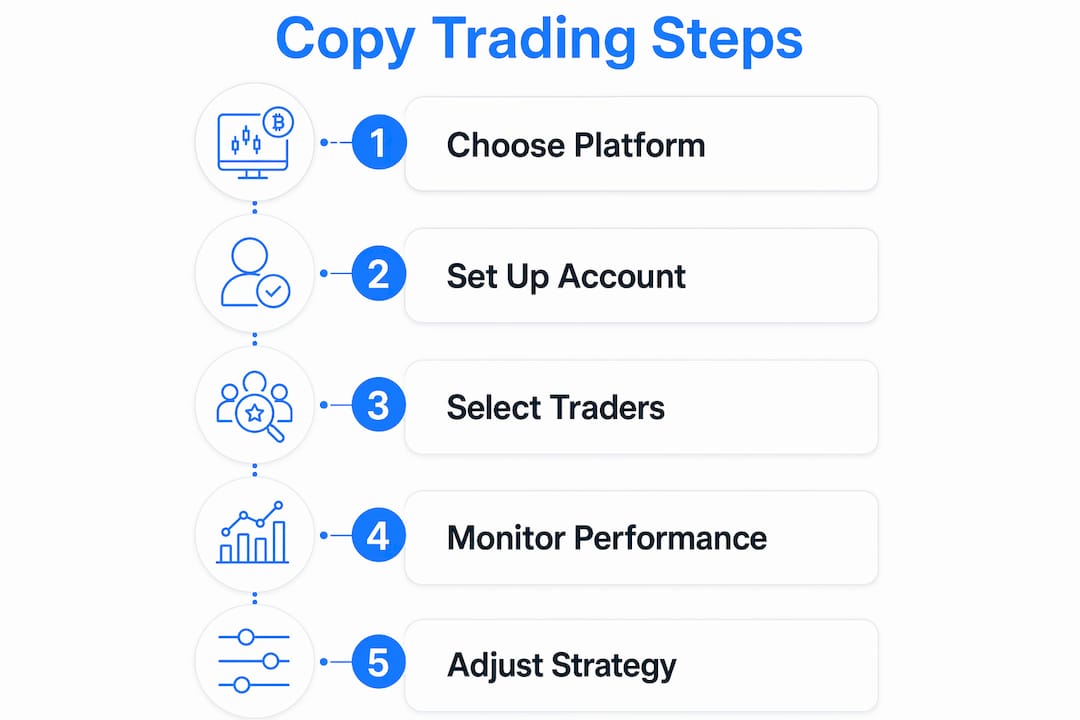
Setting up your copy trading account and configuring risk parameters
Once you have shortlisted your traders, the actual setup takes less than 30 minutes on most platforms. Here is the step-by-step process:
- Navigate to the copy trading section of your platform. On Binance, this is under "Copy Trading" in the main menu. On Bybit, it sits under "Trading." On Bitget, it has its own dedicated tab.
- Select your first lead trader from your shortlist and click "Copy."
- Choose your copy mode. Copying can be fixed amount, fixed ratio, or a share of lead portfolio. Fixed amount means you allocate a set dollar value per trade regardless of what the lead trader invests. Fixed ratio mirrors the trader's proportional position size relative to their total capital. For beginners, fixed amount is easier to control.
- Set your allocation per trader. If you are starting with $1,500 across 5 traders, allocate $300 per trader. Never put more than 30% of your total copy capital into a single lead.
- Configure your stop-loss. Most platforms allow a maximum loss limit per trader. Set this before activating the copy. If the platform does not support per-trader stop-losses, track your exposure manually and be prepared to stop copying manually.
- Activate and record your baseline. Note the exact date, allocation, and trader metrics at the time you start. This becomes your reference point for future performance reviews.
A few practical realities to keep in mind:
- Follower results can diverge from lead traders due to slippage, latency, leverage differences, and asset access. Your copy of a trade will rarely be identical to the original.
- Fees vary by platform. Some charge a profit share on gains from lead traders. Others charge flat subscription fees. Understand the fee model before committing capital.
- Execution timing is a real risk. Even seconds of latency can degrade trade results, particularly in fast-moving markets.
How to monitor and optimize your copy trading portfolio
The setup is the beginning, not the end. Active monitoring separates beginners who grow their portfolio from those who quietly lose money over three months without understanding why.
The single most important rule: wait at least 30 to 60 days before making any changes. Reacting to a two-week losing streak by switching traders is the most common and most costly mistake in copy trading. Short-term variance is normal. Evaluating a trader after two weeks is like judging a restaurant after one meal.
Here is how to build a disciplined review process:
- At 30 days: Compare each trader's current equity curve to their historical pattern. Are they behaving consistently? Any dramatic change in trade frequency or position size is worth noting.
- At 60 days: Identify any trader whose drawdown has exceeded your preset stop-loss threshold. Remove them if the limit is breached. Do not wait for a recovery that may not come.
- At 90 days: Rebalance by removing the bottom-performing trader from your list and replacing them with a newly vetted candidate from the leaderboard. Apply the same evaluation framework you used initially.
- At 6 months: Adjust allocations based on stable performance. Increase allocation to traders who have delivered consistent results. Reduce exposure to those with high variance even if their returns look acceptable.
Pro Tip: Most beginners break even or lose money during the first 6 months. Treat this period as tuition, not failure. The goal in months 1 through 6 is to learn which trader types and strategies fit your risk tolerance, not to maximize returns.
Avoid two specific emotional traps. The first is chasing new top performers who appeared on the leaderboard last week. The second is ignoring drawdown because a trader's overall return is still positive. Both behaviors lead to the same outcome: larger losses than necessary.
Common mistakes and safety tips for beginners
Copy trading carries real financial risk. Copy trading does not eliminate market or execution risk, and understanding where things go wrong is as important as knowing what to do right.
The most frequent beginner errors are:
- Skipping trader evaluation entirely. Copying the top name on a leaderboard without reviewing drawdown history, trading style, or strategy duration is not investing. It is gambling with extra steps.
- Over-investing too early. Committing your entire savings to copy trading in month one removes your ability to recover from the learning curve. Start with capital you can afford to lose entirely.
- Ignoring leverage mismatches. If a lead trader uses 5x leverage and you copy them at 1x, your position size and risk profile are completely different from theirs. Understand how your platform handles leverage before copying futures traders.
- Misreading copy trading as passive income. Copy trading requires active engagement on risk controls. Followers who set it and forget it for months without reviewing performance are the ones who discover large losses too late.
- Skipping platform disclosures. Regulatory misunderstanding is common among beginners. Read what the platform discloses about execution, fees, and your rights as a follower before depositing funds.
"Copy trading is a tool for market access, not a substitute for judgment. The beginner who treats it as a hands-off money machine is the one who learns the hardest lessons."
Start with spot trading. Add futures only after you have completed at least one full review cycle and understand how your chosen platform handles leveraged positions for followers.
Key takeaways
Successful copy trading for beginners depends on disciplined trader selection, proper risk configuration, and consistent portfolio review rather than chasing returns.
| Point | Details |
|---|---|
| Start with spot trading | Spot copy trading removes liquidation risk, making it the right entry point for beginners. |
| Evaluate traders by drawdown | Max drawdown over 90 to 180 days is a more reliable metric than headline return percentages. |
| Diversify across 4 to 6 traders | Spreading $1,000 to $2,000 across multiple lead traders limits the damage from any single strategy failing. |
| Set stop-losses before you start | Configure per-trader loss limits at 1.5 times historical max drawdown before activating any copy. |
| Treat month 1 to 6 as tuition | Most beginners break even or lose money early. Use this period to learn, not to maximize gains. |
Why copy trading rewards patience more than speed
I have watched a lot of beginners approach copy trading the same way they approach a slot machine: pick the flashiest number, put money in, and expect results. The ones who actually build something from it do the opposite. They spend more time on trader evaluation than on anything else, and they treat the first three months as a calibration exercise rather than a profit target.
The part that most guides skip is the emotional difficulty of watching a trader you copied go through a 15% drawdown in week two. Everything in you wants to stop copying them and find someone who is "working." But that reaction, repeated across enough beginners, is exactly why most people lose money in copy trading. The drawdown is often normal. The panic is the actual problem.
What I have found genuinely useful is treating your copy portfolio like a small fund. You are the portfolio manager. The lead traders are your underlying assets. You review them on a schedule, you rebalance with discipline, and you do not make allocation decisions based on last week's performance. That mental model changes everything about how you interact with the platform.
One more thing worth saying plainly: the fee structure matters as much as the strategy. Most exchanges take a profit share from your copy trading gains, which compounds against you over time. Platforms that charge a flat subscription instead of taking a cut of your profits give you a structural edge, especially in the early months when returns are inconsistent.
— Taneem
Start copy trading smarter with Nanodata

Nanodata is built specifically for traders who want to copy across multiple exchanges without giving up a share of their profits. While most platforms charge a percentage of every gain you make, Nanodata operates on a flat £20 monthly subscription. You keep everything you earn. The platform aggregates leaderboards from the top 8 crypto exchanges and supports copy trading across 20 or more exchanges from a single interface. For beginners who want to apply the evaluation framework in this article without juggling multiple accounts or paying hidden fees, Nanodata removes the friction and the profit drain that makes copy trading less worthwhile on traditional platforms.
FAQ
What is crypto copy trading for beginners?
Crypto copy trading automatically mirrors a lead trader's positions into your account in real time. Beginners use it to gain market exposure without managing trades manually, though it still requires active risk management.
How much money do I need to start copying crypto trades?
The recommended starting range is $1,000 to $2,000, spread across 4 to 6 lead traders. This amount allows proper position sizing without concentrating too much risk on any single trader.
Is copy trading the same as passive income?
Copy trading is not passive income. It is delegated execution that requires you to actively monitor lead traders, set stop-losses, and rebalance your portfolio regularly to protect your capital.
Which platforms support crypto copy trading?
Binance, OKX, Bybit, and Bitget all offer built-in copy trading features. Nanodata supports copy trading across 20 or more exchanges from a single platform with a flat subscription fee instead of profit sharing.
Should beginners copy spot or futures traders?
Beginners should start with spot copy trading. Spot trading removes liquidation risk while still providing market exposure. Futures copying introduces leverage risk that is difficult to manage without prior experience.